
The Free Max Pain Calculator finds the strike price at which the most open options contracts would expire worthless on a given expiration date. This strike — the "Max Pain" — is widely watched because price often drifts toward it as expiration approaches, a pattern sometimes called "pinning."
Free to use. No account required.
What this tool does
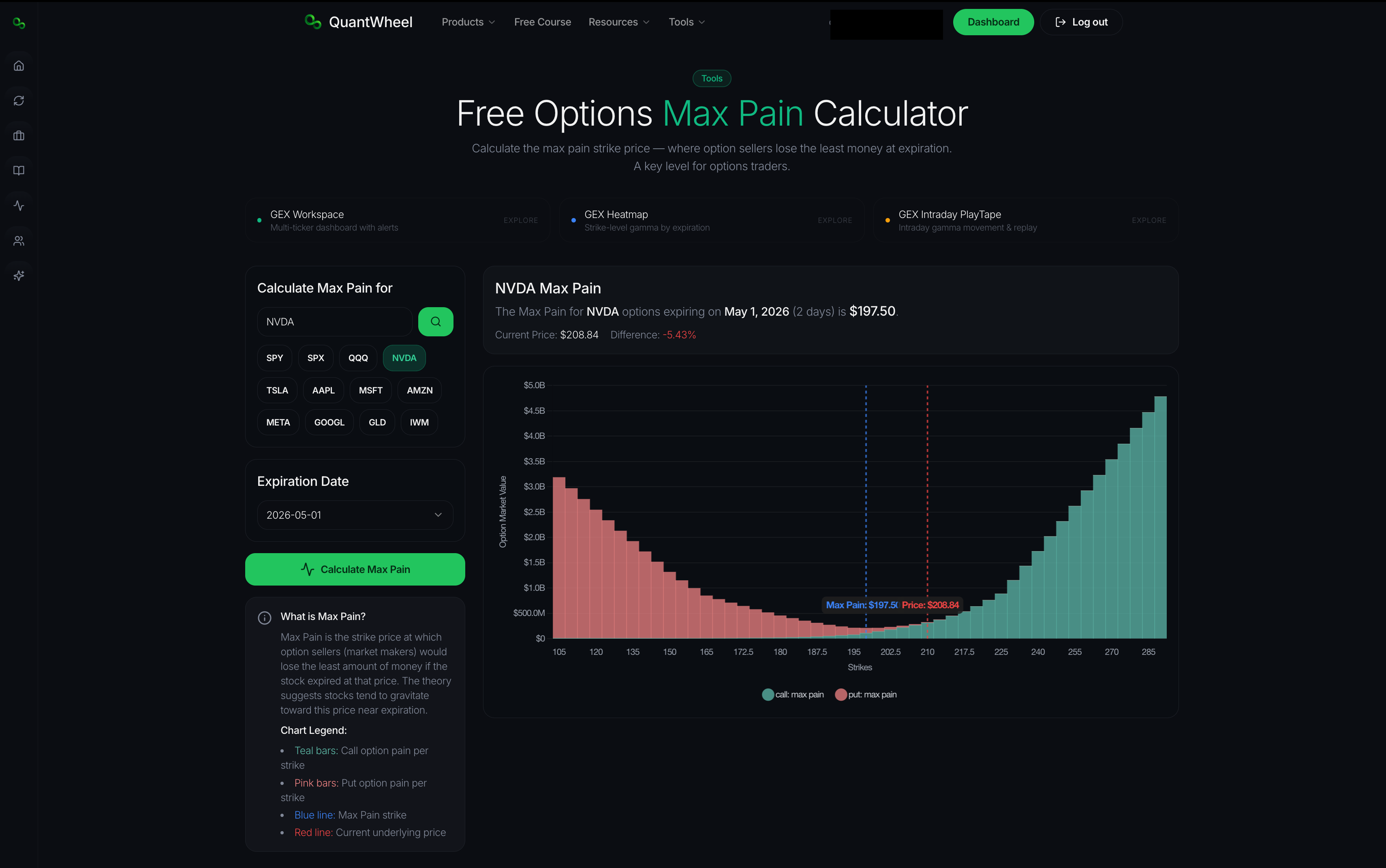
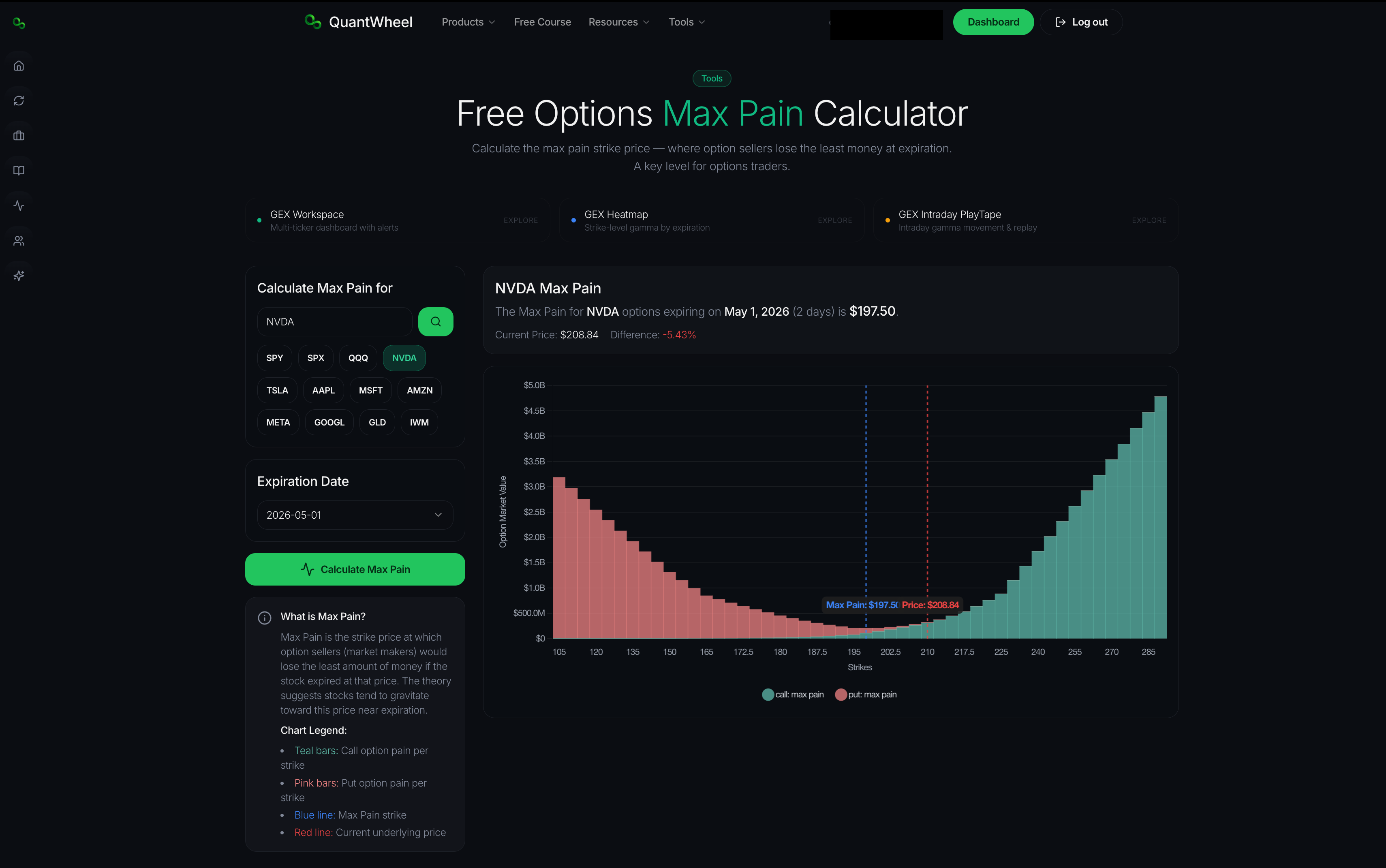
At every strike, the calculator computes the total value of all outstanding call and put contracts that would expire worthless if the underlying closed at that strike. The strike where this combined value is minimized — where options traders collectively lose the most — is the Max Pain strike.
Outputs:
- Max Pain Strike — the calculated pin level for the selected expiration
- Current Price — the underlying's last price
- Difference % — gap between current price and Max Pain
- Bar chart — option market value by strike, with Max Pain highlighted
Who it's for
Options traders watching expiration-week action. Max Pain is particularly useful for:
- Intraday traders the day of or day before expiration, when pin behavior is strongest
- Traders pairing Max Pain with GEX levels for a complete expiration-week map
- Anyone trying to understand why a stock seems "stuck" near a specific level into expiration
How to use it
- Enter a ticker in the input field
- Pick an expiration date — options with more open interest produce stronger Max Pain signals
- Click Calculate
- Compare the Max Pain Strike to current price — the smaller the gap, the more likely pinning takes effect
- Check near expiration — Max Pain matters most in the final 1-2 days before expiration
How to interpret the result
Max Pain close to current price (within 1%): pin behavior may be in effect. Range-bound action into expiration is structurally reinforced.
Max Pain far from current price (over 3%): unlikely to exert meaningful magnetism. News or momentum usually dominates.
Max Pain at a strike you didn't expect: the market's open interest is concentrated differently than visible price action suggests. Worth investigating which specific contracts drive the calculation.
When Max Pain fails
Max Pain is a statistical tendency, not a rule. It fails when:
- News breaks that overwhelms the structural pin
- Price is too far from Max Pain to realistically reach it by expiration
- Implied volatility is elevated — the pin dynamic weakens when premium dominates
- Meme-stock or short-squeeze dynamics are active — retail flow and unusual hedging can override typical expiration behavior
Treat Max Pain as context, not as a trading signal on its own.
Limitations of the free version
The Free Max Pain Calculator gives you a single-expiration snapshot. For deeper analysis you typically want:
- Multi-expiration comparison — seeing Max Pain for weekly, monthly, and quarterly expirations simultaneously
- Historical tracking — watching how Max Pain has moved over days as open interest shifted
- Integration with GEX — combining Max Pain with Call Walls, Put Walls, and the Gamma Flip
- Alerts — getting notified when price approaches Max Pain into expiration
These live in QuantWheel's authenticated Max Pain view and the broader GEX suite.
Related tools
- Free GEX Calculator — gamma exposure and dealer positioning levels
- Free GEX Heatmap — 2D view of gamma across strikes and expirations
- How to find max pain strikes — the authenticated Max Pain tool with richer features